
Published October 27, 2026
What a Sound Interior Painting Contract Must Include
A good interior painting contract is not a formality. It is the one place where "I assumed you'd do that" becomes "it says so on page one." Before you sign anything, check that the document covers the following in plain language.
Scope. The contract should list every room by name and say whether ceilings, trim, baseboards, doors, door frames, closets and cabinets are in or out. "Paint interior" is not a scope. If a room, closet or stairwell is excluded, write that down, because that is where end-of-job disputes start.
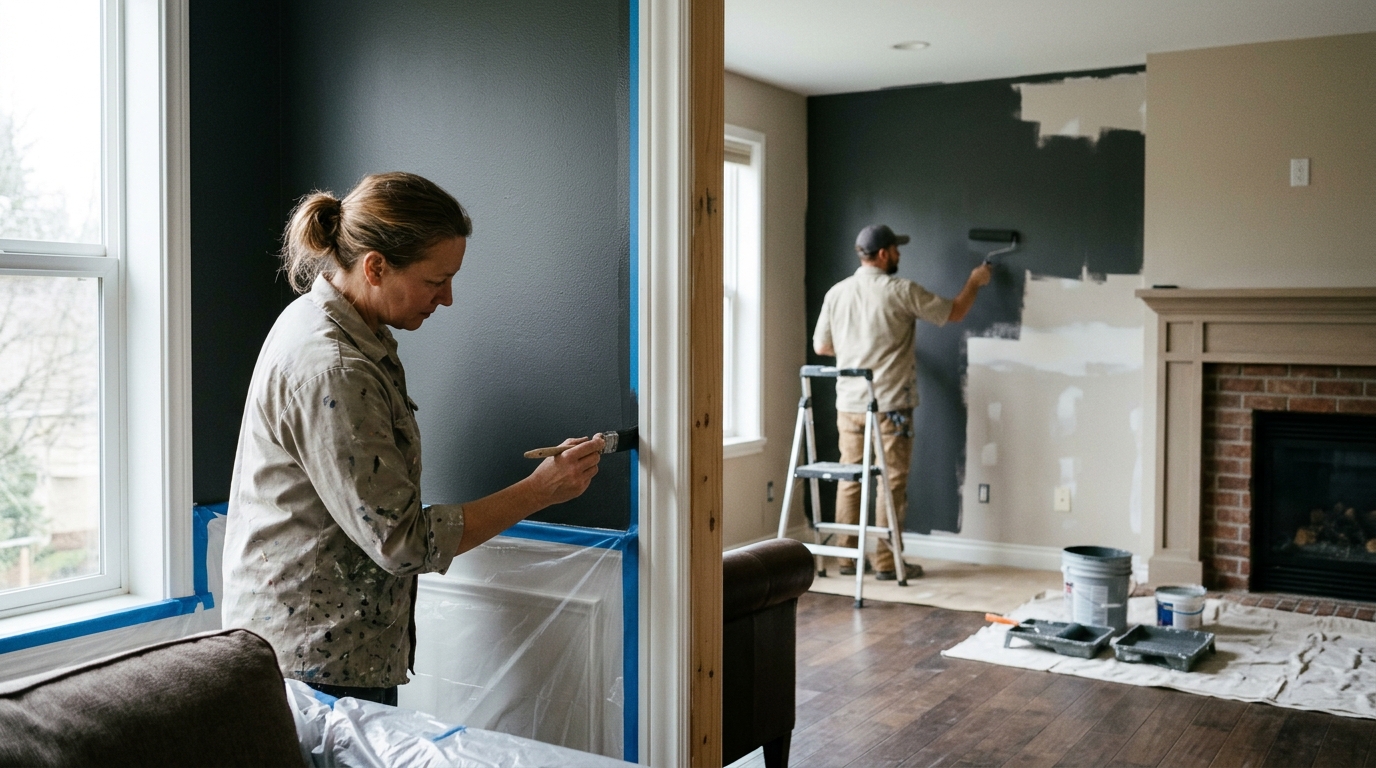
Preparation and protection. State who moves furniture, how floors and fixtures get covered, what gets patched, caulked and sanded, and what daily cleanup looks like. Prep is the part of the job you can't see once the final coat is on, which is why it has to be written, not implied. The next section shows how to pin it down.
Materials and coats. Name the paint brand and product line, the sheen for each surface and the number of coats, primer included. A quote that says "two coats" without naming the product or sheen lets a contractor pick the cheapest option that technically qualifies.
Money and calendar. Look for a total price, a payment schedule tied to milestones rather than dates, a start date and an estimated completion window. Be wary of large deposits. A modest one that holds your slot is common, but the balance should follow completed work and your sign-off. Template guides such as UpCounsel's painting contract essentials cover the basics (scope, payment, timeline, change orders, warranty) and make a useful checklist to hold a bid up against.
Change orders and warranty. We cover change orders below. For the warranty, ask what it covers (peeling, blistering, adhesion failure), for how long, and what it excludes. Most workmanship warranties don't cover new damage or moisture problems.
If you want a quote that spells these items out line by line, our interior painting page explains how we scope a job, and you can start a written estimate request there.
How to Read Prep Lines Against PCA P14 Levels
Most homeowners compare quotes by the bottom line, then wonder why two painters 40% apart both say "full prep." What's missing is a shared vocabulary for prep, and the industry has one: PCA P14, the Painting Contractors Association's standard for repainting previously painted surfaces. It exists to describe levels of preparation and give criteria for estimating, so two bids can be compared like for like. You can read the full text in the PCA P14 standard, and we summarize it on our PCA P14 prep levels page.
P14 defines four levels, from Level 1 (Basic) to Level 4 (Supreme). The level you choose affects both the look of the finish and the price, so the standard says to weigh appearance against cost. Level 1 is essentially cleaning and spot attention. Level 4 calls for thorough filling and sanding to remove defects that create abrupt differences in the surface profile of more than 1/32 inch, and it is normally recommended only where the surface is in good enough shape to justify it. That matters in a house with raking light from a big window or a glossy sheen on the walls, where every ridge and patch shows.
The standard also grades the starting condition of the surface, from DSD-0 (sound) to DSD-4 (substrate damage). Surfaces rated DSD-3 or DSD-4 call for restoration or resurfacing, not ordinary repaint prep. A wall with failing joint tape or water damage shouldn't be priced as a standard repaint at all.
Here's how to use this when reading a quote. Find the prep line. If it says "prep as needed" or "minor repairs included," ask which P14 level that means and get it in writing. If one bid is $1,500 lower, check whether it quotes Level 1 or 2 while another quotes Level 3. Higher isn't always better: a rental turnover may not need Level 4, while a living room with a dramatic sheen probably does. What matters is that the level is chosen deliberately, written down and priced accordingly.
Verifying L&I Registration, Bond and Insurance
Washington painters don't hold a "license" the way some states issue one. They register with the Department of Labor & Industries (L&I), post a bond and carry general liability insurance. The L&I-derived consumer brochure on hiring a contractor describes that framework, which applies to contractors who work, advertise or bid in the state.
Don't take a painter's registration on trust. Under Washington's contractor registration law, an unregistered contractor generally can't enforce a contract in court, which leaves the legal risk with you. Verification takes about five minutes:
- Search L&I's "Verify a Contractor" tool by company name, registration number or UBI number.
- Confirm the registration is active, not expired, and that the business name matches your contract exactly.
- Check the bond and insurance information on file, and note any violations or claims against the bond.
- Ask for a certificate of insurance and have the insurer or issuing agent confirm it's current. The Washington contractor insurance and bond requirements guide walks through the process.
One caution on figures. Published sources disagree on the bond amount for specialty contractors like painters. The older L&I-derived brochure lists $6,000, while newer summaries, including the Washington painting contractor requirements overview, list $15,000. Don't rely on either number from an article, this one included. Confirm the current amount on L&I's website, and treat anything below it as a red flag.
Bond vs. Insurance: What Protects You
Homeowners often hear "licensed, bonded and insured" as one phrase and assume it's a single blanket guarantee. It's three separate things, and the difference between a bond and insurance is worth understanding before a problem makes it urgent.
A surety bond is a financial guarantee that protects the customer. If a registered contractor violates the registration law, say by abandoning a job or failing to pay a supplier, an injured customer may be able to file a claim against the bond. It's typically a modest sum, so it's a backstop, not a refund for a failed project. And a bond is not insurance, as insurance specialists stress: the bond protects the customer, while insurance protects the contractor.
General liability insurance covers accidental damage and injury caused by the work: a ladder through a window, a can of paint dropped on your hardwood, an injured third party. It answers the common question of who pays if the painter damages your floors. It should be the painter's policy, not your homeowner's, but only if the policy is active and the damage falls within its coverage. A certificate of insurance is the evidence, and it should show a current policy period.
Workers' compensation is the other layer. If a crew member is hurt in your home, the question of who pays should already have an answer. Ask directly whether the company covers its employees, and get the answer in writing.
The practical takeaway: ask for the registration number, the bond information, a current certificate of insurance and confirmation of workers' coverage, and file copies with your contract. A contractor who hesitates on any of these is telling you something.
Cost Ranges, Written Estimates and Change Orders
Everyone wants a number, and the honest answer is that published numbers vary widely. Angi's national figures put the average interior paint job at $2,022, with most projects between $965 and $3,089. Those averages blend single-room jobs with whole-home repaints, and none of them are Puget Sound prices, so treat them as a rough yardstick, not a prediction for Everett. Labor, not paint, is usually the bigger share of the bill, which is why prep level, ceiling height and trim footage move the price more than paint brand does.
The standard advice, echoed in Angi's guidance on hiring a painter, is to collect written estimates from at least three contractors. The goal isn't just to find the cheapest. It's to see where the bids differ. If two quotes list the same rooms, paint and P14 level, and a third is far lower, the third is probably leaving something out. Ask it what.
A written estimate should be itemized enough to show what you're paying for: rooms, surfaces, prep scope, products, coats, labor and payment schedule. Vague one-line estimates invite change orders, because every gap in the scope becomes an argument later.
A change order is a written amendment, signed by both sides, that adds or removes work and states the price and any schedule impact. Your contract should say no extra work is billed without one. That protects you from a surprise invoice, and it protects an honest painter from a client who later disputes extras. If a painter proposes added work verbally ("while we're here, we should also..."), get it in writing before you approve it.
Lead-Safe Rules and Mid-Job Surprises
Two situations can derail an otherwise tidy contract: old paint and hidden damage. A good contract anticipates both.
Everett and the surrounding area have plenty of pre-1978 homes, and federal rules treat those differently. The EPA's Renovation, Repair and Painting (RRP) Rule applies to paid work that disturbs lead-based paint in pre-1978 homes and child-occupied facilities. A firm doing covered work must be trained and certified, follow lead-safe work practices, and give you the EPA's "Renovate Right" pamphlet before starting. Washington's lead program runs through the Department of Commerce, which certifies RRP firms. Some guide and vendor sources cite more than 6 square feet of disturbed interior paint per room as the trigger, but confirm that with the EPA before relying on it. If your home predates 1978, ask the painter in writing whether they're RRP-certified and whether the scope involves sanding, scraping or demolition that would trigger the rule.
The second surprise is what's behind the paint. Once old finish is scraped or a wall is opened, a painter may find soft drywall, water staining, active moisture or mold. This is where the P14 condition ratings matter: DSD-3 or DSD-4 damage is a restoration problem, not a repaint problem, and it won't fit inside the original price. Your contract should say what happens then: work on the affected area pauses, the painter documents the problem, a written change order covers any repair, and you decide how to proceed. Drywall patching and texture matching can often be folded in, and our drywall repair service is built for exactly that, but moisture and mold need their source fixed first. Painting over either is a cosmetic fix that's likely to fail.
Last, walk the job before final payment. Check surfaces in daylight and raking light against the prep level you agreed to, list the touch-ups, and hold the last payment until the list is closed. To see what finished work looks like, our portfolio shows recent Everett-area projects, and you can learn more about how we work on our about page.